The values at the “base” of the pyramid are zero, and increase linearly on each side to 65,535.
This sort of figure might be useful when testing an optical flow algorithm.
Some Linux distros in the past set the APM default very aggressively, leading your hard drive to hundreds and thousands of load/unload cycles in too short period of time.
Typically HDD are only rated for 600,000 load/unload cycles, so it might be beneficial to reduce this cycling, at the expense of some additional power consumption.
The procedure below is informational, and may or may not provide benefit.
You can slow down the cycling manually, but the system will FORGET this setting upon reboot.
Make HDParm setting semi-permanent:
make line hdparm -B 250 /dev/sda, where /dev/sda is the HDD you’re wanting to stop cycling.
This setting allows the drive to unload after an extended period without use, perhaps helping the HDD run a bit cooler without excessive wear.
Instead of 250 you could use 254, which is thought to disallow unloading altogether.
Try 254 and monitor HDD temperature–100 degrees Fahrenheit is possible.
To check how many load/unload cycles you’re using, go into Disk Utility, SMART data, and scroll down to Load/Unload cycle count.
The Seagate Momentus XT 500GB hybrid hard drive (4GB SSD, 500GB HDD) is a useful way to speedup system boot and execution.
However, on brand new files the speed is the same as a typical hard drive.
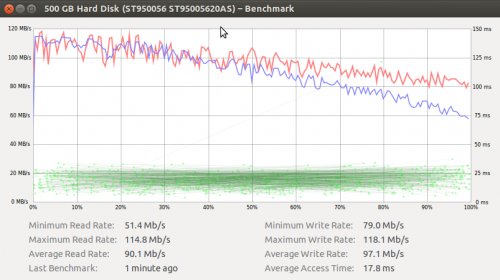
A USB 3.0 drive adapter shows what the drive could do over a USB 3.0 link, using Disk Utility on Ubuntu.
Average read speed: 90MB/sec.
Average write speed: 97MB/sec.
magnetic bottle: pitch angle distribution vs. mirror height
equipotential lines -> parallel E-field (Stephen Knight 1970)
-> Large scale, dull auroral arc
inertial alfven wave connection to parallel E-field
fine scale arcs assosciated with Farley-Buneman instabilities, GPS scintillation
energy to produce electron-ion pair ionization potential ~ 18 eV takes on average ~ 35 eV
energy deposition physics
single particle motion, 3 adiabatic invariants, Debye length, two fluid vector potential
Alfven wave can couple to whistler mode
Auroral emissions: Bohr model of atom. have to release energy gap between orbitals (work function).
Vibrational modes
Ions: closure current
electrons: field aligned current
Inertial alfven wave: electron mass matters due to phase speed > speed of light F=ma inertial limit
inerital lag – prevents group velocity from exceeding speed of light